Friday, February 29, 2008

Bush says US not headed into a recession

WASHINGTON - President Bush said Thursday the country is not recession-bound and, despite expressing concern about slowing economic growth, rejected for now any additional stimulus efforts. "We acted robustly," he said.

"We'll see the effects of this pro-growth package," Bush told reporters at a White House news conference, acknowledging that some lawmakers already are talking about a second stimulus package. "Why don't we let stimulus package 1, which seemed like a good idea at the time, have a chance to kick in?"

Bush's view of the economy was decidedly rosier than that of many economists, who say the country is nearing recession territory or may already be there. "I'm concerned about the economy," he said. "I don't think we're headed to recession. But no question, we're in a slowdown."

The centerpiece of government efforts to brace the wobbly economy is a package Congress passed and Bush signed last month. It will rush rebates ranging from $300 to $1,200 to millions of people and give tax incentives to businesses.

On one issue particularly worrisome to American consumers, there are indications that paying $4 for a gallon of gasoline is not out of the question once the summer driving season arrives. Asked about that, Bush said "That's interesting. I hadn't heard that. ... I know it's high now."

Bush also telegraphed optimism about the U.S. dollar, which has been declining in value.

"I believe that our economy has got the fundamentals in place for us to ... grow and continue growing, more robustly hopefully than we're growing now," he said. "So we're still for a strong dollar."

Bush also used his news conference to press Congress to give telecommunications companies legal immunity for helping the government eavesdrop after the Sept. 11 terrorist attacks.

He continued a near-daily effort to prod lawmakers into passing his version of a law to make it easier for the government to conduct domestic eavesdropping on suspected terrorists' phone calls and e-mails. He says the country is in more danger now that a temporary surveillance law has expired.

The president and Congress are in a showdown over Bush's demand on the immunity issue.

Bush said the companies helped the government after being told "that their assistance was legal and vital to national security." "Allowing these lawsuits to proceed would be unfair," he said.

More important, Bush added, "the litigation process could lead to the disclosure of information about how we conduct surveillance and it would give al-Qaida and others a roadmap as to how to avoid the surveillance."

The Senate passed its version of the surveillance bill earlier this month, and it provides retroactive legal protection for telecommunications companies that wiretapped U.S. phone and computer lines at the government's request and without court permission. The House version, approved in October, does not include telecom immunity.

Telecom companies face around 40 lawsuits for their alleged role in wiretapping their American customers.

Senate Democrats appeared unwilling to budge.

As Bush began speaking, Senate Judiciary Committee Chairman Patrick Leahy, D-Vt., cast the president's position as a "tiresome campaign...to avoid accountability for the unlawful surveillance of Americans."

"The president once again is misusing his bully pulpit," Leahy said. "Once again they are showing they are not above fear-mongering if that's what it takes to get their way."

Bush criticized the Democratic presidential candidates over their attempts to disassociate themselves from the North American Free Trade Agreement, a free-trade pact between the U.S., Canada and Mexico. Bush said the deal is contributing to more and better-paying jobs for Americans.

"The idea of just unilaterally withdrawing from a trade treaty because of, you know, trying to score political points is not good policy," he said. "It's not good policy on the merits and it's not good policy as a message to send to people who have in good faith signed a treaty and worked with us on a treaty."

Democratic Sens. Hillary Rodham Clinton and Barack Obama are feuding over NAFTA as they compete for their party's presidential nomination, as the pact is deeply unpopular with blue-collar workers. Though neither has said they were ready to pull the United States out of the agreement, both say they would use the threat of doing so to pressure Mexico to renegotiate tougher labor, environmental and enforcement provisions.

Bush fended off a question about why he has yet to replace Fran Townsend, his White House-based terrorism adviser, who announced her resignation more than three months ago. He said the job is being ably filled by her former deputy, Joel Bagnal.

On another issue, Bush said that Turkey's offensive against Kurdish rebels in northern Iraq should be limited — and should end as soon as possible. The ongoing fighting has put the United States in a touchy position, as it is close allies with both Iraq and Turkey. A long offensive along their border could jeopardize security in Iraq just as the U.S. is trying to stabilize the war-wracked country.

"The Turks need to move, move quickly, achieve their objective and get out," he said.

On Russia, Bush said he does not know much about Dmitry Medvedev, the handpicked successor to President Vladimir Putin who is coasting to the job. Bush said it will be interesting to see who represents Russia — presumably either Medvedev or Putin — at the Group of Eight meeting later this year in Japan.

The president advised his own successor to develop a personal relationship with whomever is in charge in Moscow.

"As you know, Putin's a straightforward, pretty tough character when it comes to his interests — well so am I," Bush said. He said that he and Putin have "had some diplomatic head butts."

Bush also said, however, that the pair have "a cordial enough relationship to be able to deal with common threats and opportunities, and that's going to be important for the next president to maintain."

Bush also defended his stance of not talking directly with leaders of adversaries such as Iran and Cuba without setting preconditions. In doing so, he offered some of his strongest criticism yet of Raul Castro, who assumed Cuba's presidency on Sunday after his ailing brother Fidel, who ruled for decades, stepped aside.

"Sitting down at the table, having your picture taken with a tyrant such as Raul Castro, for example, lends the status of the office and the status of our country to him," Bush said.

He said that Raul Castro is "nothing more than an extension of what his brother did, which is ruin an island."

Following his news conference, Bush traveled to the Labor Department to meet with his economic advisers.

Afterward, he expressed confidence in the nation's ability to weather the economic downturn.

"We'll make it through this period just like we made it through other periods of uncertainty during my presidency," Bush said.

Original here

The 10 Worst Products For Men Ever Created

heidelberg.jpg

While much as been said about the way advertisers have always hawked their products to women by playing on their insecurities, men have not been immune from similar pitches. While they may worry less about crow’s feet than ladies do, there are still some things that make men feel insecure. Hoping to capitalize on these insecurities, some downright wacky products have been sold.
Here are the top 10 worst products ever made for men:

Products for Hair Loss

The telltale signs of shedding hair in the sink can worry even the most self-assured of men. Companies have long recognized this and marketed hundreds of different products to stop, slow, or cover thinning hair. From hair plugs to toupees, none of them truly achieved the desired effect. Here are some of the worst hair loss products ever invented:

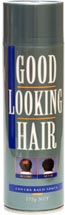
Hair in an Aerosol Can

glh_can.jpg

The “spray” from this can is actually made of tiny fibers that stick to your head and hair. Just spray it all over and-poof!-thinning hair is thick and full and bald spots are gone.

The idea behind the spray is to help insecure balding men feel more confident. But can there be anything more confidence-sapping than having to worry that a spontaneous swim, rainstorm, or excessive sweating will melt your hair off?

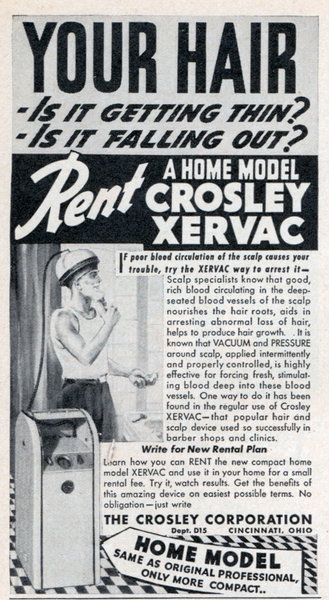
Crosely Xervac Head Vacuum

lrg_xervac.jpg

This large device (which you could rent for home use) operated on the principle that sucking more blood into your scalp area would make hair grow healthy and strong and prevent it from falling out. A hose attached to a skull cap surrounded your head with suction power. This reminds me of Garth using the Suck-Cut on Wayne’s World. “It’s sucking my will to live, man!”

Chest Hair Toupee

chesthair.JPG

While some men shave or laser their chest to achieve a smooth, hairless look, other, naturally smooth chested men, pine for a manly carpet of chair. For these men, the chest hair toupee was invented. Available in black, brown, or gray, these chest pieces are made of real human hair. How do you even apply this thing? Glue? Tape? At any rate it is perfect for its target audience: middle-age men who like to wear halfway unbuttoned Hawaiian shirts and yet are lacking the tuft of hair sticking out that is necessary to complement their gold chain necklaces.

Products for the Prostate

Another area in which many men feel insecure is their sexual prowess. Some of the wackiest inventions ever made were designed to help the male libido.

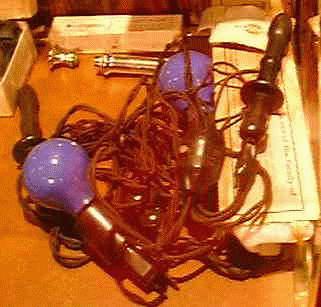
The Prostate Warmer

prostate-warmer.jpg

Invented in 1918, this device promised to “stimulate the abdominal brain!” (I am not sure what that is, although men have long been accused of thinking with it). The device consisted of a 4.25 inch probe which was plugged into the wall and then inserted into the rectum. When plugged in, a blue light bulb lit up to tell you it was working to restore your manly vitality. Brings new meaning to the phrase “blue light special.”

Radioactive Jockstrap

Radioactive materials were once thought to impart healing and vitalizing powers to people. Radium was infused into drinking water, baths, and even suppositories. Perhaps the scariest way it was administered was through a radioactive jockstrap for men. ”Weak Discouraged Men!” one advertisement proclaimed. ”Now Bubble Over with Joyous Vitality Through the Use of Glands and Radium.” Joyous Vitality…..and glow in the dark junk.

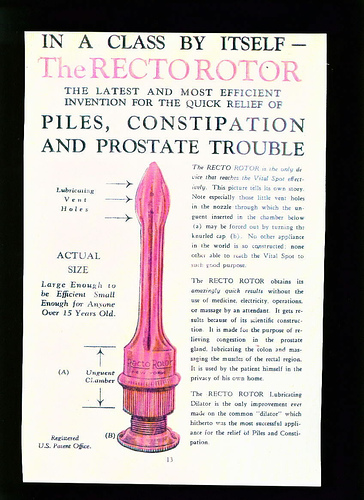
Recto Rotor

rector-rotor.jpg

This dilator promised to cure “piles, constipation, and prostrate problems.” It was designed to break up, your, um, “piles” and to lubricate the rectum. The tip had holes in it through which ointment could be released. How it was supposed to cure your prostate problems can only be imagined. But with a motto like “large enough to be efficient, small enough for anyone over 15 years old,” how could you go wrong?

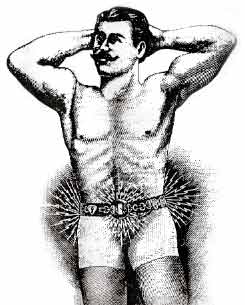
Heidelberg Electric Belt

heidelberg.jpg

In the early 1900’s many people believed they were suffering from “neurasthenia,” a disease cause by modernization and over-stimulation. This “sickness” produced a wide variety of symptoms from depression to impotency to fatigue. The Heidelberg electric belt, touted as a cure, sent electricity to your genitals and promised to restore your vitality and strength. Ouch.

Anti-Self Pollution Devices

During the 1800’s and early 1900’s, extreme measures were recommended to control the sexual libido of young men. Several devices were invented to prevent men from masturbating. Here at the Art of Manliness we support self-discipline and harnessing the male libido, but genital mutilation is definitely not the way to do it.

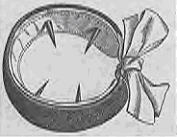
Spike lined ring

ring.gif

This device was aimed not only at preventing masturbation, but nocturnal emissions as well. Young men would tie this ring of death around their member, and whenever they became aroused, the spikes would sink into their flesh, causing excruciating pain.

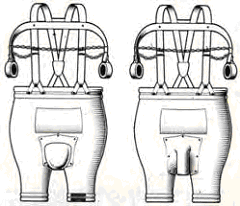
Spermatic Truss

truss.gif

The spermatic truss, patented in 1876, was designed to make erections impossible by binding the genitalia down. 21 years later, the designer changed the truss a bit, making erections possible. The only downside? An erection would now drive the genitalia against painful spikes.

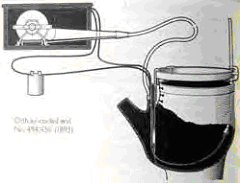
The Timely Warning

warning.gif

Invented by Frank Orth in 1893, The Timely Warning was a penis cooling apparatus designed to prevent wet dreams. A man would attach the device to his penis before he went to bed. When an erection occurred during the night, levers opened to allow cold water to flow through tubes around the genitalia. This cooled “the organ of generation, so that the erection subsides and no discharge occurs.” Basically, it was like taking a cold shower, but without the shower.

Original here

The Future Was Then

The Times Have Caught Up With That Erstwhile Icon of Modernity, the Sharper Image


For all of its flaws as a business, nobody can accuse the Sharper Image of over-promising. The name explains precisely what it can do for you. Spend money here, it says, and we will improve the way you are perceived. You want an actual enhancement? Try the Greater Substance store, if one opens up. Until then, drop some money in this gleaming gadgetorium and bask in the regard of your awestruck friends.

Until last week, this seemed like a surprisingly durable premise. Then the company filed for Chapter 11 bankruptcy protection and announced it would close 90 of its roughly 180 stores "as soon as possible." Two days ago, it added to the air of doom by announcing that its shares, which were recently trading for a mere 45 cents, would be delisted from the Nasdaq.

But where will I kill time while my wife shops, you hear a few million husbands murmuring to themselves. Fair question. The company is likely to remain alive in some kind of dramatically altered shape, analysts say. (A few messages left at the company's headquarters in San Francisco were not returned.) But you don't need to stick the Grill/Fork Thermometer -- which "measures the internal temperature of chicken, beef, pork and fish" -- into the Sharper Image to grasp the obvious: The place, as we've known it, is done.

What are we losing? A world of luminescent safety leashes, hideaway gyms, telescoping ladders -- an entire chain dedicated to the idea of streamlining your life by .002 percent. The Sharper Image is a place that sells a lighted nose-hair trimmer, which is to say it targets men who already own a regular nose hair trimmer in the hopes they'll think it's worth $40 to get a better look up their nostrils. Bought a fine bottle of wine? Why throw it in a bucket of ice when for $99.95 you can treat yourself to a "professional wine chiller" with 33 built-in settings, and chill that Chablis to its optimum temperature.

This was a Sharper Image forte: taking the guesswork out of realms in which you never knew you were guessing. The ideal product is a contraption that stands this close to the realm of the purely inane. Which is to say that although the product mix now includes hair dryers and "miracle food storage" containers, it's basically a store for men. Especially men in desperate need of a gift, especially a gift for a man -- arguably the most desperate creature in all of giftdom. The store is filled with objects that say, "I had no idea what to get you, but I spent some real money."

Here's a NeatReceipts Scanalizer 3.0. Enjoy.

Of course, if you don't have your heart set on a Scanalizer, odds are good you won't actually use it. For countless Sharper Image products, there is the sad and inevitable migration that starts in the office, moves to a closet, then to the attic and finally, a year or two later, to the front lawn for a yard sale, where the $50 desktop power shredder is priced to move at $15. It waits next to an old adding machine and a red plaid thermos until a neighbor picks it up from a table ("Does this thing work?") and the journey starts all over again, at a different address, with a fresh set of batteries.

Given that the product mix hasn't changed much since the store debuted in 1977, why is the Sharper Image hurting now? Certainly, this is a lousy time to be in the luxury gizmo business. As market researcher Jack Plunkett put it in a phone interview: "If you're suffering economically, how important is it to run out and buy a $3,000 vibrating chair?"

The company also made a bunch of strategic missteps. It relied too heavily on blockbuster products, like the Razor scooter. It sold a ton of Ionic Breeze air purifiers, which Consumer Reports panned so viciously in 2002 that a class action lawsuit was filed against Sharper Image for refunds. (A judge's rejection of a settlement to that lawsuit -- she didn't like the $19 store coupon proposed for each Ionic owner -- seemed to precipitate the Chapter 11 filing.)

It doesn't help that so much of the stuff at Sharper Image is now sold all over the place, in Best Buys, through hundreds of online stores. Maybe there was a time when customers would spend $1,000 for a Panasonic camcorder that can be acquired through B&H Photo for $785. (Yes, that's a real, present-day example.) But not anymore.

The Sharper Image also has a well-funded rival in Brookstone, which was acquired three years ago by an Asian company that specializes in high-end massage chairs. Exactly how Brookstone is faring isn't clear, because Osim, its new owner, is privately held. But those massage chairs are a high-margin item.

"So in addition to other problems, the Sharper Image's biggest competitor is attacking one of their core categories," says Scott Tilghman of Soleil Securities-Hudson Square Research. "That hurt."

But even if the Sharper Image had sidestepped all of these bear traps, it was headed for trouble. Once, a visit to the store seemed like a trip to the future's very own showroom, or a museum exhibit called "What Is Next." Brushed aluminum was the surface of choice, back when only very cool stuff had a brushed aluminum surface. Staffers dressed in head-to-toe black and looked like they could serve drinks on the space station.

Well, they looked like that in 1984. Today, they could be baristas.

It's not just that the idea of the future as curated by the Sharper Image now seems hopelessly dated. (Although ask any 22-year-old about the store and get ready for an eye roll.) It's that the number of curators of the future has exploded. If you want to stoke your gadget lust, you head to Gizmodo or Engadget, two of roughly 74 million gadget blogs. Or you head to the Apple Store, or Circuit City.

Even for the chain that brought us the Equalizer Foot Pro Massager, it's hard to keep your image sharp in that much company.

Original here