Monday, May 26, 2008

The 10 Most Annoying Habits of Technology Companies

Fed up with rebate hassles, nagging software, and skimpy support? So are we! The everyday practices of hardware, software, and Web firms can drive their customers bonkers. Here's how to fight back.

Rick Broida, PC World


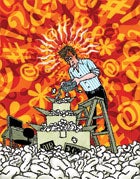
The 10 Most Annoying Habits of Technology Companies illustration
Illustration: Edwin Fotheringham

May we vent for a minute? Much as we love technology, sometimes we get fed up with the companies that provide it. Maybe it's the notice saying that important features of our perfectly good money-management software no longer work just because it's a couple of years old. Maybe it's the new PC we just bought, so loaded with unwanted junkware that it takes minutes to boot and runs like molasses. Or maybe it's the way we're forced to switch to a certain behind-the-times carrier if we want to buy a certain way-cool phone. (Oh, and that fairly new operating system we don't like, don't want, and can't escape? Don't even go there.)

Yeah, we're fed up, all right. And we're not the only ones: We surveyed readers at PCWorld.com and found that you've had your fill of such annoying policies and practices as well. (Be sure to see more on the results of our informal poll.) Hoping for a little retribution--or at least some explanations--we went knocking on the doors of Apple, Intuit, Sony, Symantec, and other perpetrators of bad behavior. We didn't always receive good answers (or sometimes any answer--Apple didn't bother to return our calls), but we did put these companies on notice: Annoyed customers frequently turn into ex-customers.

Who got served? Here's our list of some of the most annoying practices (and practitioners), along with suggestions for working around the hassles or avoiding them altogether.

Original here

BBC placed on dirty list for ‘propping up’ Burma junta

The BBC is to be named in a “dirty list” of companies accused of helping to prop up Burma’s military rulers.

BBC Worldwide, the corporation’s commercial arm, will be criticised for promoting tourism to the country, despite pleas from Burma’s pro-democracy movement for holidaymakers to stay away.

The broadcaster has become embroiled in the row following its acquisition of a majority stake in Lonely Planet, which publishes a travel guide to Burma. Critics claim that the guide helps the junta to achieve its goal of luring more western tourists to fill its coffers.

Opponents of General Than Shwe’s dictatorship also claim that forced labour has been used to build facilities such as new hotels and an international airport at Mandalay.

The annual blacklist of companies accused of aiding or helping to fund the junta will be published on June 3 by the Burma Campaign UK, a London-based pressure group.

BBC Worldwide will be the highest-profile new entry. It will join about 150 other companies with business interests in Burma, including Total and Chevron, the oil giants.

Superdrug and 3 Mobile are also on the list because Hutchison Whampoa, which owns both companies, has links to Rangoon.

“Tourism provides a financial lifeline to the regime and the BBC should not be supporting it,” said Johnny Chatterton, the group’s campaigns officer.

Politicians and rival media organisations accused BBC Worldwide last year of “empire building” after it reportedly paid £75m for a 75% stake in Lonely Planet. The deal caused controversy because it appeared to have little to do with the BBC’s broadcasting remit.

Aung San Suu Kyi, the Burmese pro-democracy leader and a Nobel peace prize winner, has previously called for tourists to boycott the country. Rough Guides, another travel publisher, has refused to print a book about Burma.

BBC Worldwide said: “Lonely Planet believes its decision to publish a guidebook to Burma does not represent support or otherwise for the current regime. It provides information and lets readers decide for themselves.”

Original here

Potential Facebook IPO keeps investors speculating

By Anupreeta Das

NEW YORK (Reuters) - Will it, won't it? If so, when? If not, why not? An entire cottage industry of speculation has built up around the public debut of Facebook, arguably Silicon Valley's hottest Internet company.

Mark Zuckerberg, Facebook's founder and chief executive, has remained mum on the social network's IPO plans, except to tell CBS's 60 Minutes in January that a 2008 IPO is "highly unlikely."

That hasn't stopped bloggers and investors from interpreting Facebook's every move as preparation for an eventual public offering.

That Facebook has been steadily expanding its ranks -- it now employs 550 people, according to the company -- and recently hired a string of Google Inc (GOOG.O: Quote, Profile, Research) executives, including Sheryl Sandberg, Google's former sales chief who is the new Facebook chief operating officer, has only fed the speculation.

A Facebook spokeswoman declined to comment.

Venture capitalists say the excitement around Facebook is warranted given the explosive growth in membership. The social network has more than tripled the number of active members to 70 million from about 20 million in April 2007.

Advertisers are attracted by the huge opportunity presented by social networks, where millions of people often post their interests and tastes on their online profiles. This online behavior allows advertisers to target their messages specifically to groups of people.

"Social media is going to be mainstream, it's going to be ubiquitous," said Mayfield Fund managing director Navin Chaddha at the Reuters Global Technology, Media and Telecoms summit this week.

"It's where people are going to hang out," he said, adding that the next Yahoo Inc (YHOO.O: Quote, Profile, Research) or Google Inc is going to emerge from among the crop of these Web 2.0 start-ups.

WEB 2.0

That's the main reason why Web 2.0 companies -- called so because the Web-based programs they offer are more dynamic and interactive than dot-com era companies -- are getting large valuations.

Software giant Microsoft Corp (MSFT.O: Quote, Profile, Research) took a $240 million stake in Facebook last year, valuing the four-year-old company at $15 billion.

That's slightly more than the $14.7 billion market value of HJ Heinz Co (HNZ.N: Quote, Profile, Research), according to Reuters data, but less than half that of Yahoo, whose market cap was $37.6 billion.

"(Facebook) is not riding a crest," said Bob Davis, general partner at Highland Capital Partners. "It is the crest in terms of what's taking place out there today."

Following the Facebook funding, in January Slide Inc -- a start-up that lets people create their own photo slide shows to put on their social network profiles -- received a $50 million round of funding, valuing the company at about $500 million.

Facebook's popularity is so immense that "despite the lackluster IPO market, if they chose to go public tomorrow, they could," Davis said at the Reuters Summit.

But the overall market for initial public offerings remains daunting for most companies this year. Only five U.S. venture-capital backed companies went public in the first quarter of 2008, compared to 18 in the same period last year, according to data from the National Venture Capital Association, a trade group.

The founder of A Small World, the Facebook for high-fliers, told the Reuters Summit in Paris that market turbulence was also preventing it from making a public debut in Europe.

"If the market was super-hot, we'd be considering a flotation," said founder and Chairman Erik Wachtmeiste.

Some venture capitalists said they've asked start-ups they fund to shore up cash for the next year or so, until the public markets open their wallets for their debuts.

"But Facebook is in an enviable position," Highland's Davis said. "It can afford to sit it out."

(Editing by Brian Moss)

Original here