Thursday, July 10, 2008

Soldier Sues Army, Saying His Atheism Led to Threats

FORT RILEY, Kan. — When Specialist Jeremy Hall held a meeting last July for atheists and freethinkers at Camp Speicher in Iraq, he was excited, he said, to see an officer attending.


Ed Zurga for The New York Times

Specialist Jeremy Hall, 23, outside Fort Riley, Kan., where he has been stationed since being sent home early from Iraq because of threats from fellow soldiers.

Kevin Moloney for The New York Times

Mikey Weinstein, founder of the Military Religious Freedom Foundation, talking to cadets at the Air Force Academy.

But minutes into the talk, the officer, Maj. Freddy J. Welborn, began to berate Specialist Hall and another soldier about atheism, Specialist Hall wrote in a sworn statement. “People like you are not holding up the Constitution and are going against what the founding fathers, who were Christians, wanted for America!” Major Welborn said, according to the statement.

Major Welborn told the soldiers he might bar them from re-enlistment and bring charges against them, according to the statement.

Last month, Specialist Hall and the Military Religious Freedom Foundation, an advocacy group, filed suit in federal court in Kansas, alleging that Specialist Hall’s right to be free from state endorsement of religion under the First Amendment had been violated and that he had faced retaliation for his views. In November, he was sent home early from Iraq because of threats from fellow soldiers.

Eileen Lainez, a spokeswoman for the Defense Department, declined to comment on the case, saying, “The department does not discuss pending litigation.”

Specialist Hall’s lawsuit is the latest incident to raise questions about the military’s religion guidelines. In 2005, the Air Force issued new regulations in response to complaints from cadets at the Air Force Academy that evangelical Christian officers used their positions to proselytize. In general, the armed forces have regulations, Ms. Lainez said, that respect “the rights of others to their own religious beliefs, including the right to hold no beliefs.”

To Specialist Hall and other critics of the military, the guidelines have done little to change a culture they say tilts heavily toward evangelical Christianity. Controversies have continued to flare, largely over tactics used by evangelicals to promote their faith. Perhaps the most high-profile incident involved seven officers, including four generals, who appeared, in uniform and in violation of military regulations, in a 2006 fund-raising video for the Christian Embassy, an evangelical Bible study group.

“They don’t trust you because they think you are unreliable and might break, since you don’t have God to rely on,” Specialist Hall said of those who proselytize in the military. “The message is, ‘It’s a Christian nation, and you need to recognize that.’ ”

Soft-spoken and younger looking than his 23 years, Specialist Hall began a chapter of the Military Association of Atheists and Freethinkers at Camp Speicher, near Tikrit, to support others like him.

At the July meeting, Major Welborn told the soldiers they had disgraced those who had died for the Constitution, Specialist Hall said. When he finished, Major Welborn said, according to the statement: “I love you guys; I just want the best for you. One day you will see the truth and know what I mean.”

Major Welborn declined to comment beyond saying, “I’d love to tell my side of the story because it’s such a false story.”

But Timothy Feary, the other soldier at the meeting, said in an e-mail message: “Jeremy is telling the truth. I was there and witnessed everything.”

It is unclear how widespread religious discrimination or proselytizing is in the armed forces, constitutional law experts and leaders of veterans’ groups said. No one has independently studied the issue, and service members are reluctant to come forward because of possible backlash, those experts said.

There are 1.36 million active duty service members, according to the Pentagon, and since 2005, it has received 50 formal complaints of religious discrimination, Ms. Lainez said.

In an e-mail statement, Bill Carr, the Defense Department’s deputy under secretary for military personnel policy, said he “saw near universal compliance with the department’s policy.”

But Mikey Weinstein, a retired Air Force judge advocate general and founder of the Military Religious Freedom Foundation, said the official statistics masked the great number of those who do not report violations for fear of retribution. Since the Air Force Academy scandal began in 2004, Mr. Weinstein said, he has been contacted by more than 5,500 service members and, occasionally, military families about incidents of religious discrimination. He said 96 percent of the complainants were Christians, and the majority of those were Protestants.

Complaints include prayers “in Jesus’ name” at mandatory functions, which violates military regulations, and officers proselytizing subordinates to be “born again.” After getting the complainants’ unit and command information, Mr. Weinstein said, he calls his contacts in the military to try to correct the situation.

Skip to next paragraph
Kevin Moloney for The New York Times

At center, the chapel at the Air Force Academy in Colorado Springs. In 2005, new rules went into effect after cadets complained that evangelical Christian officers proselytized on campus.

“Religion is inextricably intertwined with their jobs,” Mr. Weinstein said. “You’re promoted by who you pray with.”

Specialist Hall came to atheism after years as a Christian. He was raised Baptist by his grandmother in Richlands, N.C., a town of fewer than 1,000 people. She read the Bible to him every night, and he said he joined the Army “to make something of myself.”

“I thought going to Iraq was right because we had God on our side,” he said in an interview near Fort Riley.

In the summer of 2005, after his first deployment to Iraq, Specialist Hall became friends with soldiers with atheist leanings. Their questions about faith prompted him to read the Bible more closely, which bred doubts that deepened over time.

“There are so many religions in the world,” he said. “Everyone thinks he’s right. Who is right? Even people who are Christians think other Christians are wrong.”

Specialist Hall said he did not advertise his atheism. But his views became apparent during his second deployment in 2006. At a Thanksgiving meal, someone at his table asked everyone to pray. Specialist Hall did not join in, explaining to a sergeant that he did not believe in God. The sergeant got angry, he said, and told him to go to another table.

After his run-in with Major Welborn, Specialist Hall did not file a complaint with the Army’s Equal Opportunity Office because, he said, he was mistrustful of his superior officers. Instead, he told leaders of the Military Association of Atheists and Freethinkers, who put him in touch with Mr. Weinstein. In November 2007, Specialist Hall was sent home early from Iraq after being repeatedly threatened by other soldiers. “I caution you that although your ‘legal’ issues are yours and yours alone, I have heard many people disagree with you, and this may be a cause for some of the perceived threats,” wrote Sgt. Maj. Kevin Nolan in Specialist Hall’s counseling for his departure.

Though with a different unit now at Fort Riley, Specialist Hall said the backlash had continued. He has a no-contact order with a sergeant who, without provocation, threatened to “bust him in the mouth.” Another sergeant allegedly told Specialist Hall that as an atheist, he was not entitled to religious freedom because he had no religion.

Responding to questions about Specialist Hall’s experience at Fort Riley, the staff judge advocate, Col. Arnold Scott, said in an e-mail message, “In accordance with Army policy, Fort Riley is committed to ensuring the rights of all its soldiers are protected, including those of Specialist Hall.”

Civilian courts in the past have been reluctant to take on military cases, and the Justice Department has yet to respond to Specialist Hall’s lawsuit.

“Even if it doesn’t go through, I stood up,” Specialist Hall said. “I don’t think it is futile.”

Original here

No doubt it's torture, says U.S. journalist after trying waterboarding

Author and journalist Christopher Hitchens says it was difficult finding someone who would agree to waterboard a man of 60. Author and journalist Christopher Hitchens says it was difficult finding someone who would agree to waterboard a man of 60. (Christian Witkin/McClelland & Stewart)
Christopher Hitchens, a Washington-based journalist known for his support of the Iraq war and the U.S. war on terror, has subjected himself to waterboarding.

The experiment was done in answer to critics who challenged him to try it after he defended U.S. treatment of Muslim prisoners.

The controversial interrogation technique, which simulates drowning, is the focus of an intense debate in U.S. political circles.

Washington has been divided over whether or not waterboarding can be called torture since it was learned the technique was used by the CIA on at least three detainees, one of them being Khalid Sheik Mohammed, who is accused of plotting the Sept. 11 attacks.

The experience left Hitchens with no doubts. The August issue of Vanity Fair will carry his article titled "Believe Me, It's Torture."

Hitchens told CBC News he decided waterboarding was torture while talking with U.S. forces specialists about it after the experience.

He'd lasted, he estimated, less than 10 seconds under the technique. "I would defy anyone to stand more — people with better lungs than me and people who are younger," he said in an interview Monday.

"I'm nearly 60 — which actually made it difficult to get this done because people who were capable of doing it said they wouldn't because at my age it could kill me."

Hitchens went into the experience with a code word he could shout and an agreed-upon physical signal which would let the specialists know he'd had enough.

But he said the experience was still terrifying.

"I was suddenly grabbed from behind and pinioned and a hood pulled over my head, a sort of balaclava helmet. It admitted some light but I couldn't really see," he said. "I was turned around a few times I think to disorient me so I didn't know which direction I was facing."

He was then taken to a shed with strobe lights flashing and metallic music playing.

"With my hands handcuffed to a belt, I then had my arms very tightly wrapped close to my torso so I couldn't move anything above my waist and then the same was done to my legs. I was placed on a board which was a shallow incline, but one that put my head below the level of my heart."

Hitchens said he couldn't move at all.

"Then two or three levels of towel were placed on the outside of my face so I was completely oblivious to the outside world, couldn't hear or see anything and was wondering how I was going to carry on breathing … and then water began coming through the towel into my nostril and that was the situation."

A wet hand was also held over his face and breathing in caused the wet towel to cover his nose.

"It had the effect very rapidly of inducing a panic and gag reflex," Hitchens said. "It's almost impossible to avoid doing that, even though … you have some idea of what's coming and what's going on, your system overrides your brain in a sense and all you want to do is make sure you're not breathing water."

The experience has had after-effects — including bad dreams and a feeling of panic that returns whenever he is breathless, he said.

In an article last year in Slate, Hitchens attempted to draw a distinction between what he called techniques of "extreme interrogation" and "outright torture."

But his Vanity Fair article makes no such distinction.

Coming from a writer who has been a strong defender of the U.S. conduct in Iraq and against Muslim prisoners, Hitchens's experience has attracted attention in Washington.

"I can only judge from the reactions I've had so far, including from some people who are supporters of the administration in general on the war on terror who say they agree with me that it's not something that the U.S. should be doing to its prisoners," Hitchens said.

There is "a feeling a line has been crossed, that we're using methods we would have condemned if they were used by an enemy," he added.

Original here

Iran Gen.: Our finger is always on the trigger

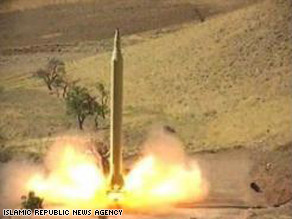
TEHRAN, Iran (CNN) -- Iran test-fired a long-range missile on Wednesday in response to what it says are threats from Israel and the United States, Iranian officials said.

Iran says this test-firing was a success.

Iran says this test-firing was a success.

"We want to tell the world that those who conduct their foreign policy by using the language of threat against Iran have to know that our finger is always on the trigger and we have hundreds and even thousands of missiles ready to be fired against predetermined targets," Gen. Hossein Salami, commander of the Revolutionary Guard ground forces, said on state TV.

"We will chase the enemies on the ground and in the sky and we are able react strongly to enemy's threats in shortest possible time."

Iran's Islamic Revolutionary Guard Corps test-fired a Shahab-3 missile and several other missiles during war games in the Persian Gulf called the Great Prophet III, according to Iran's state-run media and a U.S. military source.

William Burns, a senior U.S. State Department official, said Iran is "as serious ... a problem as any we face today."

The exercise comes a month after Israel conducted a military drill in the eastern Mediterranean involving dozens of warplanes, and the latest Iranian activities prompted concern from Israel and condemnation from the United States.

Iran occasionally tests missiles, but this firing comes amid international tensions over its nuclear aspirations.

The state-run Islamic Republic News Agency said "the war game was aimed at improving the combat readiness of Iran's armed forces. The 2,000-kilometers-range Shahab-3 missiles were tested to demonstrate Iran's capability in hitting its enemies accurately at the early stages of their probable attacks against the Islamic Republic."

The agency added: "Domestic and foreign political and military analysts believe that Shahab-3 is able to reach targets in the occupied lands in case of the Zionist regime's probable attacks against Iran's nuclear sites."

Iran's Press TV said the military "successfully test-fired new long and mid-range missiles." It mentioned the Shahab 3, "which can hit any target within a range of 2,000km." It said the missile was equipped with a one-ton conventional warhead.

"Nine highly advanced missiles with improved accuracy were simultaneously tested including the Zelzal and Fateh missiles with ranges of 400km and 170km respectively."

Press TV said troops were also involved in the maneuvers in the Persian Gulf and Strait of Hormuz areas.

A U.S. military official with knowledge of the testing counted the firing of seven missiles, one Shahab-3 and six shorter-range ballistic missiles. The testing took place over land, the official said.

The official, who noted that these kinds of tests had occurred before and were not unexpected, said the tests were tracked by U.S. intelligence.

Another military source said another Iranian exercise is under way inside the Persian Gulf with surface ships and submarines.

World powers, who suspect Iran is intent on building nuclear weapons, have offered economic and other incentives in exchange for the suspension of its enrichment program.

Iran, which says its nuclear program is strictly to produce energy, defends its right to proceed with enrichment.

There are worldwide worries that Israel, which is concerned by Iran's plans, is pondering a unilateral strike.

Israel's recent aerial military exercise was in part an effort to send a message that it has the capability to attack Iran's nuclear program.

The distance involved in the exercise was roughly the same as would be involved in a possible strike on the Iranian nuclear fuel plant at Natanz, a U.S. military official said.

In 1981, Israel attacked a nuclear facility in Iraq. Israel also struck a site in Syria that some say was a nuclear reactor under construction.

One Israeli Cabinet member, Shaul Mofaz, recently said it "will attack" Iran if the nuclear program was not halted.

Last week, the Islamic Revolutionary Guard Corps commander, Gen. Mohammed Ali-Jaafari, said any strike against Iran's nuclear facilities would be regarded a the beginning of war.

At the same time, Iranian leaders are discounting the possibility of war. President Mahmoud Ahmadinejad, in Malaysia this week for a conference, told reporters Iran was trying to prevent a confrontation.

"We are making all-out efforts to expand peace and security in the world. You should not be concerned about a new war," he said on Tuesday.

Mark Regev, spokesman for Israeli Prime Minister Ehud Olmert, said it did not want conflict with Iran.

"But the Iranian nuclear program and the Iranian ballistic missile program must be of concern for the entire International community," Regev said.

The White House reacted strongly to the Iranian test-firing.

U.S. National Security Council spokesman Gordon Johndroe said: "Iran's development of ballistic missiles is a violation of United Nations Security Council resolutions and completely inconsistent with Iran's obligations to the world."

Johndroe mentioned that the U.S., Britain, France, Russia, China and Germany "are committed to a diplomatic path, and have offered Iran a generous package of incentives if they will suspend their uranium enrichment activities."

"They should also refrain from further missile tests if they truly seek to gain the trust of the world. The Iranians should stop the development of ballistic missiles, which could be used as a delivery vehicle for a potential nuclear weapon, immediately."

Original here