Sunday, November 16, 2008

Legal battle over forest is victory for Paraguayan Indians

By Arthur Brice

(CNN) -- A small tribe of Indians in Paraguay who have had virtually no contact with the outside world won a legal battle this week when rights groups stopped a Brazilian company from continuing to bulldoze the forest to clear land for cattle ranches.
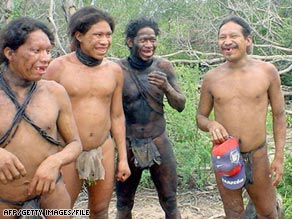
About 2,000 members of the Ayoreo ethnic group live in 13 settlements in Bolivia and Paraguay.

About 2,000 members of the Ayoreo ethnic group live in 13 settlements in Bolivia and Paraguay.

The Totobiegosode tribe, said to number no more than 300, is the last group of uncontacted Indians in South America outside the Amazon River basin, indigenous rights groups say.

The Totobiegosode, who are part of the larger Ayoreo ethnic group, are nomadic Indians who hunt and fish, as well as gather fruit and honey and cultivate small temporary plots during the rainy season. They live communally, four to six families to a dwelling, in the dense forests of northwestern Paraguay.

Two Brazilian companies have been rapidly clearing land the Totobiegosode live on, and the tribe has lost nearly 15,000 acres (about 6,000 hectares) this year, according to British-based Survival International, an advocacy organization for the rights of tribal people.

A ruling Thursday by Paraguay's secretary of the environment canceled a special permit for one of the companies, Yaguarete Pora S.A., to clear the land.

The legal battle is being waged by local groups such as GAT, an acronym in Spanish for People, Environment and Territory. The activist groups have undertaken the fight without the knowledge of the Totobiegosode.

Indian rights proponents see Thursday's ruling as an important victory.

"This sends a very significant signal," said Jonathan Mazower, campaign coordinator for Survival International. "Until now, the ranchers and the landowners have really had it all their own way. They are very politically powerful and well-funded. ... This may be a sign that the government is starting to get a grip on the situation."

As their territory has been gobbled up, some Totobiegosode have been spotted by other Indians retreating deeper into the vanishing jungle: a group of eight or nine men on one occasion, a smaller group several days earlier, Survival International reported in a release Friday.

The problems for the larger Ayoreo ethnic group, who share a common language and culture and can be found in Bolivia and Paraguay, started about 50 years ago. Between 1959 and 1987, most Ayoreos were forced off their ancestral land, according to the World Rainforest Movement, which describes itself as international network of citizens' groups involved in efforts to defend the world's rainforests.

About 2,000 Ayoreos live in 13 settlements: 10 in Bolivia and three in Paraguay, the rainforest group says.

Only the Totobiegosode tribe still lives in the forest, without contact with other Ayoreos or foreigners, in an area known as Amotocodie.

Although no one has any direct contact with the Totobiegosode still in the jungle, their presence can be seen by such signs as footprints and holes in trees that indicate they have been gathering honey, the rainforest group says. There also have been occasional sightings in the distance.

Mazower said he interviewed a small group of Totobiegosode who made contact with the outside world in 2004 and who described what their life is like.

"We were always running," Mazower said one Indian told him. "We would suddenly hear these bulldozers. We thought that it was a kind of monster that could smell us. We could see fire. We were very afraid, and we ran."

The bulldozers, Mazower said, are much larger than the commercial bulldozers seen at construction sites. Often, crews will string a chain between two bulldozers, which will move in tandem to cut down an increased number of trees.

As a result, many groups of Totobiegosode are fragmented into isolated patches as they scatter, divided by areas with no forest and increasingly busy roads. Families can be separated, and their lives become increasingly difficult, Mazower said.

By Survival International's reckoning, the forest where the Totobiegosode live is being destroyed at a faster rate than the Amazon jungle as a whole.

Despite Thursday's ruling, some observers say the future of tribes still living in the jungle in Paraguay and elsewhere, particularly Brazil, does not bode well.

"It's almost impossible in some sense to protect these tribes," said Peter Hakim, president of the Inter-American Dialogue, a Washington-based policy center.

The reason, he said, is the same as it has been since the Western world started being colonized more than 500 years ago: "There's a lot of money to be made."

Original here

Downed US spy plane now ‘property’ of MILF rebels

By Al Jacinto, Correspondent

ZAMBOANGA CITY: Philippine Muslim rebels recently shot down a US spy drone flying inside their territory in the restive southern region of Mindanao, where American forces are aiding local troops in fighting separatist and communist insurgents.

Mohagher Iqbal, a senior leader of the Moro Islamic Liberation Front (MILF), on Friday said that the drone had been captured by rebel forces in the hinterlands of Talayan town in Maguindanao province.

He added that the spy plane was shot down on the night of October 31. Iqbal said the rebels recovered the plane on November 1 and the MILF leadership announced the capture of the drone on the same day.

Iqbal did not say whether the drone was armed or had a thermal and infrared video camera, only that the aircraft had a wing span of eight feet. He said the rebels had fired at the drone with automatic weapons.

“The spy plane is still in good condition and intact and we will not give it back to the US military. It is now the property of the MILF,” Iqbal told The Manila Times.

There were no immediate statements from either Philippine or US military officials about the shooting down of the drone.

The capture of the spy plane, though, exposed the apparent involvement of American forces in local anti-insurgency operations, which is a violation of the Constitution.

A US military spy plane also crashed in North Cotabato province near Maguindanao on October 18 after hitting a row of coconut trees. The news of the crash was kept secret by Filipino and US authorities until the local media reported about it a week later.

This plane, with a wing span of about eight feet, went down at night on a civilian neighborhood in Pikit town. Policemen quickly cordoned off the wreckage and returned the morning of October 18 to collect debris of the drone.

The drone is one of many spy aircraft used by US forces in surveillance operations in southern Philippines. It can be deployed for destructive missions.

There are three basic types of drones: the pre-programmed, the smart and the remotely-piloted.

A pre-programmed drone responds to an onboard timer or scheduler and has no sensor contact with the ground. The drone follows a set routine of maneuvers and altitude, speed and course changes that are programmed through an autopilot to the drone’s control surfaces and engine throttle. The drone is usually recovered by a parachute at the end of a mission.

A smart drone carries various sensors and is equipped with an onboard computer. Its ability to make decisions governing course and altitude changes is limited only by its computer and sensor capacity.

It can take off on its own from a given airport, navigate a circuituous route, make decisions en route based on weather or enemy radar action, fly to a second airport and make a safe landing.

The remotely-piloted drone, probably the most common of drones, is under the constant control of an operator or pilot through radio links. The pilot or pilots can be located on the ground, in other aircraft or on ships.

Typical missions for remotely-piloted drones include reconnaissance or surveillance of enemy activities, target acquisition, relay of friendly communications and jamming of enemy communications.

Advanced remotely-piloted drones are equipped with low-light-level television and infrared sensors that allow over-the-horizon reconnaissance imagery to be transmitted to ground commanders as it is being acquired.

In 2006, villagers in Sulu province, also in Mindanao, held for ransom an unmanned US drone that had crashed there. It was used by the Philippine military in tracking down the Abu Sayyaf, a Muslim extremist group that is linked to al-Qaeda and Jemaah Islamiah.

This drone, which was remotely-controlled, went down on February 10 in the village of Marang in Indanan town. Local television news showed footage of a villager holding the spy plane with a wing span of about one meter and slim body and a video camera mounted on its belly. The villagers demanded P100,000 in exchange for the unmanned aircraft.

Another US unmanned spy plane also crashed in November 2007 during a practice flight in Mount Tumatangis in Sulu. It was unknown if the drone was found or not, but the crash was never reported to the press.

In March 2002, a US spy drone called Predator also went down into the sea off Zamboanga City, also in Mindanao. It crashed for still unknown reasons and was also recovered.

The US military has a fleet of various unmanned spy planes, from a palm-size remote-con-trolled aircraft, to bigger and sophisticated high-altitude, long-range remotely-piloted ones designed for long-endurance photographic reconnaissance and electronic surveillance missions, and as attack aircraft.

It had used a Philippine Air Force base on Mactan island in Cebu province in central Philippines as station for its fleet of Orion spy planes.

Original here

Tuesday, November 4, 2008

Best Buy Threatens To Replace A $2200 Sony Laptop With An Asus EeePC


By Meg Marco

Is there a difference between a Sony TZ ultraportable laptop and an Asus Eee PC? Reader Ignacio bought Best Buy's accidental damage protection plan for his $2200 Sony TZ laptop, and when he did, indeed, drop it — Best Buy threatened to replace it with a $600 Asus Eee PC, and finally decided to issue a $1200 gift card — the price of a 15" Dell notebook. Fair?

Ignacio says:

I would like anyone who has considered buying this plan for a computer or has one to be aware that this warranty is useless and a waste of money. Don’t buy it.

I had purchased a Sony Vaio TZ laptop about a year ago with the accidental protection damage (ACH) for several reasons, but mainly because the sales man suggested it for such a small laptop and for how expensive it was ($2200). Buying this warranty was a peace of mind that the sales man a year ago assured me of.

Jumping forward in time, a year later, I accidentally dropped my laptop and took in for repairs at the Geek Squad. The gentleman who attended me was very helpful and assured me that I would be taken care of with what he called “a high end laptop”. As a side note he even admired the size and weight of the laptop, which was the main selling factor for these laptops from Sony and why they were so expensive.

I received a call yesterday (10/31/08) from Best Buy saying the repairs were too costly and that my laptop would be replaced under warranty. I drove there today (11/1/08) to pick up a replacement. The attendant showed me a what she referred to as a comparable model (Vaio Z) and said I could take that as a replacement or use that money($2000) towards another computer , in essence store credit. I picked out a computer that was more expensive and she said it was fine, but I had to pay the difference. When we got to the register and as she started to ring me up, she stated that she had not done this type of return before and she asked a colleague to help her. She was told it was being done incorrectly and we were sent to talk to the supervisor of the computer department. This is where the trouble began.

I was told because of the specs of my computer the most comparable model was $600, which was an Asus EEE pc, but they would do me a favor and give me $1200 for a 15” Dell. When I stated to them that neither of them were comparable, because the sized and features that the TZ, they replied that they do it spec for spec and that my laptop only had 1gig of ram, a 1ghz processor and 100gig hard drive, and that was the closest computer. When I tried to explain to them that this computer was expensive because of the size features and ultra-portability; they ignored me and threatened to make my in-store credit less than $400 for some other netbook. I said that was not fair, the supervisor printed a gift card for $1200 gave it to me walked away. I asked to speak with the store manager.

The store manager, Huff, came and I explained to him what had happened in the last hour. He tried to understand what had happened and brought the supervisor from the Geek Squad department to help him out because he admittedly said, “I am not good with computers.” The supervisor told me the same as the rest that spec for spec there is no comparable computer, and that was the best they could do and I should be happy with that and instead of $600. I asked him to check Sony’s website so he can see that even a year later the TZ models are in fact cheaper, but more than $1200, and just as comparable with the one I bought. He said that he would not check any “junk” websites and only base his decision on what they had in the store. He told me to call Best Buy, and then yelled at the manager behind me, “This conversation is over,” and left. I was left standing at the cash register in the Customer Service area.

I called Best Buy customer relations from within the store, but they were of no help. They said they would not replace base on purchase price but “comparable technology.” When I said they were being unfair about comparing my computer the attendant on the phone said that was policy and there was nothing she could do.

So basically, to summarize, I bought a premium ultra portable laptop from Sony and it was compared to an Asus EEE netbook, under replacement, or a 15” Dell brick of a laptop that is worthless and not comparable. Salesmen are misleading when they are trying to sell you something. Good thing I didn’t order my laptop with the solid state hard dive, or else a comparable model would only have 60gigs of hard dive space. That is how “knowledgeable” the Geek Squad employees are, especially when the supervisor compares a premium notebook to a netbook.

I will not buy anything from Best Buy again. I spend thousands of dollars personally and more through my business, and I often refer my friends there as well. Not anymore, customer service is bad, the prices are more expensive when compared to internet shopping, and they rip you off. I encourage anyone not to buy from Best Buy and if you have to buy something there don’t waste your money any “peace of mind” insurance plans.

-Ignacio

We think Ignacio should launch an EECB (Executive Email Carpet Bomb) and see what Best Buy has to say, but we thought we'd throw this one out to the crowd first.

So, what do you think?

Did Ignacio Get A Fair Deal?


View Results

Original here