Sunday, February 15, 2009

U.S. now sees Iran as pursuing nuclear bomb

By Greg Miller

Reporting from Washington -- Little more than a year after U.S. spy agencies concluded that Iran had halted work on a nuclear weapon, the Obama administration has made it clear that it believes there is no question that Tehran is seeking the bomb.

In his news conference this week, President Obama went so far as to describe Iran's "development of a nuclear weapon" before correcting himself to refer to its "pursuit" of weapons capability.

Obama's nominee to serve as CIA director, Leon E. Panetta, left little doubt about his view last week when he testified on Capitol Hill. "From all the information I've seen," Panetta said, "I think there is no question that they are seeking that capability."

The language reflects the extent to which senior U.S. officials now discount a National Intelligence Estimate issued in November 2007 that was instrumental in derailing U.S. and European efforts to pressure Iran to shut down its nuclear program.

As the administration moves toward talks with Iran, Obama appears to be sending a signal that the United States will not be drawn into a debate over Iran's intent.

"When you're talking about negotiations in Iran, it is dangerous to appear weak or naive," said Joseph Cirincione, a nuclear weapons expert and president of the Ploughshares Fund, an anti-proliferation organization based in Washington.

Cirincione said the unequivocal language also worked to Obama's political advantage. "It guards against criticism from the right that the administration is underestimating Iran," he said.

Iran has long maintained that it aims to generate electricity, not build bombs, with nuclear power. But Western intelligence officials and nuclear experts increasingly view those claims as implausible.

U.S. officials said that although no new evidence had surfaced to undercut the findings of the 2007 estimate, there was growing consensus that it provided a misleading picture and that the country was poised to reach crucial bomb-making milestones this year.

Obama's top intelligence official, Dennis C. Blair, the director of national intelligence, is expected to address mounting concerns over Iran's nuclear program in testimony before the Senate Intelligence Committee today.

When it was issued, the NIE stunned the international community. It declared that U.S. spy agencies judged "with high confidence that in fall 2003, Tehran halted its nuclear weapons program."

U.S. intelligence officials later said the conclusion was based on evidence that Iran had stopped secret efforts to design a nuclear warhead around the time of the U.S. invasion of Iraq.

Often overlooked in the NIE, officials said, was that Iran had not stopped its work on other crucial fronts, including missile design and uranium enrichment. Many experts contend that these are more difficult than building a bomb.

Iran's advances on enrichment have become a growing source of alarm. Since 2004, the country has gone from operating a few dozen centrifuges -- cylindrical machines used to enrich uranium -- to nearly 6,000, weapons experts agree.

By November, Iran had produced an estimated 1,400 pounds of low-enriched uranium, not nearly enough to fuel a nuclear energy reactor, but perilously close to the quantity needed to make a bomb.

A report issued last month by the Institute for Science and International Security concluded that "Iran is moving steadily toward a breakout capability and is expected to reach that milestone during the first half of 2009." That means it would have enough low-enriched uranium to be able to quickly convert it to weapons-grade material.

Tehran's progress has come despite CIA efforts to sabotage shipments of centrifuge components on their way into Iran and entice the country's nuclear scientists to leave.

Iran still faces considerable hurdles. The country touted its launch of a 60-pound satellite into orbit this month. Experts said Iran's rockets would need to be able to carry more than 2,000 pounds to deliver a first-generation nuclear bomb.

And there are indications that the U.S. and Iran are interested in holding serious diplomatic discussions for the first time in three decades. Iranian President Mahmoud Ahmadinejad said this week that his nation was "ready to hold talks based on mutual respect," and Obama indicated that his administration would look for opportunities "in the coming months."

Hassan Qashqavi, spokesman for Iran's Foreign Ministry, on Wednesday warned the U.S. not to wait for Iranian presidential elections this year, because ultimate authority rests with supreme leader Ayatollah Ali Khamenei.

He also said Iran would be patient.

"Since a new administration came to power in the U.S., we do not want to burn the opportunity of President Obama and give him time to change the reality on the ground," Qashqavi said.

But experts said Iran was now close enough to nuclear weapons capability that it may be less susceptible to international pressure.

"They've made more progress in the last five years than in the previous 10," Cirincione said.

Original here

I was forced to abduct my daughter

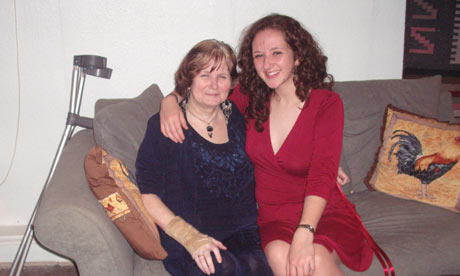
Elizabeth Prosser and Tamara

Elizabeth Prosser and Tamara. Photograph: Elizabeth Prosser

I spend most of my life in bed and in constant pain. I suffer from Crohn's disease, acute fibromyalgia, and epilepsy. Daily life is already a struggle, but soon I could be extradited from Wales to the United States for abducting my daughter.

If the extradition goes ahead, I'm not sure I'll survive the flight, let alone a court case or jail sentence. I always thought extradition was for terrorist suspects or major criminals, not people like me. I'm a 58-year-old British woman and held responsible jobs until my illness forced me to stop working four years ago.

I used to work for the American embassy. When I was 27 I moved to the Netherlands from the UK with my first husband, and began a job promoting US trade. We had three children together, but the marriage did not last and we divorced in 1982. My husband returned to the UK, and my mother moved in to help look after the children. For 12 years we were all very happy.

When my oldest son was 15 he got a scholar-ship to Manchester University and afterwards won a full scholarship to do his PhD in the US. My other children were all happy to move there and thanks to my work at the embassy, I was granted a five-year business visa in 1990. My mother, the children, our two great danes and five cats, packed up and moved to Pennsylvania where I started working as an export consultant.

Shortly after arriving, I met a local musician called Michael, and we began a relationship. Two years later, to my amazement, I became pregnant at 42. I was overjoyed and my older children, who were by now all married to US citizens, were delighted.

When my daughter Tamara was born I carried on working until 1995 when my visa was due for renewal. I had assumed this would be a formality so was shocked to be told there were too many business visas in circulation.

I was granted just a six-month extension. This was a real problem. My mother's visa had also expired and she returned to the UK. As I could not leave my children I felt I had no choice but to work illegally. Michael and I ended our relationship and it was agreed that I would bring Tamara up.

Then, to my horror, I was arrested for overstaying my visa and working illegally and placed in the local jail for six months. Conditions were grim and I was in a very small cell with four other women charged with similar offences. Michael had agreed to look after Tamara and when I was released on bail I went to court to get her back. A joint custody order was issued in 1997, making me responsible for my daughter's school fees, her clothes and effects, but allowing her father visitation rights. If I had left the US without Tamara, I would not have been able to return to the US for 10 years. And no American court would have allowed her visitation rights to another country.

As I could not live on thin air, let alone support my daughter, I began working for a local magazine. In January 1998, I was tipped off that I was going to be re-arrested and sent back to the UK alone. My three older children were all settled, but I couldn't bear the thought of being separated for ever from my five-year-old daughter - what mother could? Panic-stricken and distraught, I bought air tickets to Ireland and, despite a custody order stating Tamara could not be taken out of Pennsylvania, she and I fled the US. I did not tell Michael and he was understandably less than pleased.

We moved to Scotland, where I got a part-time job working in a holiday village. Tamara started school and although I was scared of what might happen next, I had a wonderful eight months with her. If I had my time over again I would do the same thing - the thought of being separated from her was unbearable.

One day at 6am came the knock on the door I was dreading. The police arrested me and bundled us into a car. After being driven to a car park several miles away, Tamara was snatched from my arms. I felt physically sick and she kept screaming, "I want to stay with my mummy, please don't take me away from my mummy." I was put on a plane to Heathrow with no idea what had happened to Tamara. Much later I learned that she had been put on a private jet to the United States. She was just six years old.

On arrival at Heathrow airport I was charged with kidnapping and put on remand in HMP Holloway for six months. The prison staff were sympathetic and treated me well and after six months I was out on bail. Nine months after I was arrested for abducting my daughter charges of obtaining money by deception were laid against me relating to my illegal work in the US, charges that I am vigorously fighting.

Eleven years later I remain on bail. I may not leave the principality of Wales. I may not travel. I must reside at our home.

I explored all kinds of legal options to get my daughter back, but nothing worked. I kept writing and sending gifts to my daughter's father but for two years I heard nothing. Then one day in 2001, Tamara called me. She had found one of my letters and seen my phone number. I was overjoyed to hear her voice and we stayed in regular touch by phone, letter and email.

I longed to be with her and became so depressed I sought psychological counselling where I was diagnosed with severe post-traumatic stress disorder. Luckily I met a wonderful man, Phil, and we married in 2002. But two years later, I was taken ill and my health deteriorated sharply.

Last year, to my delight, Tamara and her father came to visit us. When my daughter and I saw each other again we clung to each other for hours. I showed her some of the clothes that she'd worn the day before she was snatched - she couldn't believe I'd kept them all this time. We did not stop talking for days. With her dad's blessing she's planning to go to a Welsh university in 2010 so that she can be near me. She's very angry about what happened, but Michael has done a wonderful job of bringing her up. He does not support the extradition order and has asked his attorney to oppose it.

A sword of Damocles is hanging over us as we wait to see whether I will be extradited. I'm not a baby snatcher. I brought my own daughter to the UK because I couldn't bear to be apart from her.

I'm in very poor health. Crohn's disease has attacked my digestive system and I have a colostomy bag. I have been prescribed liquid morphine to ease the pain. A senior criminal attorney in Pennsylvania said with the inadequate health facilities available in the US prison system I would be likely to "languish in pain". If I'm extradited to the US there will be no future for me. A previous attempt to extradite me was quashed in 2005 by the then home secretary Charles Clarke. But in December government ministers upheld the earlier decision to order my surrender to the US. My solicitor is challenging this and my MP is urging the Home Office to prevent the extradition.

If I'm imprisoned in the US, Tamara cannot visit as she is a party in my crime. My mother is 89 and my husband cares for her, so we are also unlikely to see each other again. The home secretary could stop the extradition order. If I'm forced on to that plane it won't be extradition, it will be execution.

• Liz Prosser was talking to Diane Taylor.

• Do you have a story to tell about your life? Email it to my.story@guardian.co.uk. If possible, include a phone number

Original here

Details in gay student's slaying are revealed in prosecution brief

By Catherine Saillant

Lawrence "Larry" King wasn't sexually harassing fellow eighth-grade student Brandon McInerney in the weeks leading up to King's shooting death, prosecutors contend in court documents.

McInerney was the aggressor, teasing the effeminate King for weeks and vowing to "get a gun and shoot" him, according to a prosecution brief. Multiple students provided accounts of a growing hostility between the two boys, the document shows.

Their dispute ended in tragedy a year ago today when McInerney allegedly armed himself with a .22-caliber revolver and shot King in the back of the head twice in an Oxnard classroom as the school day was beginning.

"In the days before the shooting, the defendant tried to enlist others to administer a beating to Larry," Deputy Dist. Atty. Maeve Fox wrote in a "statement of facts" filed with the brief. "When that failed for lack of interest, he decided to kill Larry."

Prosecutors said they provided their most detailed account to date of the events leading to the classroom killing to counter the defense's argument that murder charges against McInerney, then 14, were improperly filed in adult court.

Defense attorney Scott Wippert contends that Ventura County Dist. Atty. Gregory Totten abused his discretion in deciding to try McInerney as an adult rather than filing charges in juvenile court. Fox said she filed the statement of facts in December to show that the case was filed properly.

The Ventura County Star published details from the document this week.

"It was an absolutely brutal crime, with premeditation and deliberation," Fox said Wednesday. "He was familiar with firearms and had fired that gun before. He knew what he was doing."

Wippert said the prosecution filing was a "one-sided version of the facts." He said it was meant to sway the jury pool before the case reaches trial.

"We don't know if any of this version of what she says happened will ever go before a court of law," Wippert said. "It was irresponsible to release it."

The one-year anniversary of the shooting is being marked in Ventura County by a candlelight march and vigil organized by a local gay-rights group. Similar memorials are being planned across the state, said Jackie Downing of the Gay-Straight Alliance Network in San Francisco.

King's death struck a chord with parents, teachers, students and gay-rights advocates concerned that McInerney's alleged bullying of King had been minimized by school authorities.

Since King's death, teachers have sought training in how to identify gay and lesbian students who might be struggling with their sexual identity. Teachers also have asked for resources to help students who have already come out or who may be experiencing bullying.

In her statement of facts, Fox contends that King and McInerney had an acrimonious relationship for months prior to the shooting. They sparred with "typical 8th grade, back-and-forth insults; some sexual, some not," she wrote.

Witnesses said King was usually not the aggressor. But after months of teasing by McInerney and other male students who called him "faggot," he had began to retort, according to prosecutors.

The day before the shooting, the two boys were bickering during seventh period. When King left, a student witness said that McInerney commented, "I'm going to shoot him."

Just after that class, another student heard King say "I love you" to McInerney as they passed in a hallway. The same student then heard McInerney say he was "going to get a gun and shoot" King, according to prosecutors.

A few minutes later, prosecutors allege, McInerney told one of King's friends: "Say goodbye to your friend Larry because you're never going to see him again."

The prosecution brief also reveals for the first time that McInerney was familiar with firearms, and that he had used that particular weapon in the past during target shooting with his family.

Investigators found a training video in his possession titled "Shooting in Realistic Environments," as well as skinhead and neo-Nazi books and similar writings from the Internet, prosecutors wrote.

"I had to tell the court what we knew at the time the decision was made to file in adult court," Fox said. "So that's what I did."

Original here