Thursday, April 17, 2008

Feds to collect DNA from every person they arrest

A strand of DNA is seen in an undated handout image. REUTERS/National Institutes of Health/Handout
Reuters Photo: A strand of DNA is seen in an undated handout image. REUTERS/National Institutes of Health/Handout

WASHINGTON - The government plans to begin collecting DNA samples from anyone arrested by a federal law enforcement agency — a move intended to prevent violent crime but which also is raising concerns about the privacy of innocent people.

Using authority granted by Congress, the government also plans to collect DNA samples from foreigners who are detained, whether they have been charged or not. The DNA would be collected through a cheek swab, Justice Department spokesman Erik Ablin said Wednesday. That would be a departure from current practice, which limits DNA collection to convicted felons.

Expanding the DNA database, known as CODIS, raises civil liberties questions about the potential for misuse of such personal information, such as family ties and genetic conditions.

Ablin said the DNA collection would be subject to the same privacy laws applied to current DNA sampling. That means none of it would be used for identifying genetic traits, diseases or disorders.

Congress gave the Justice Department the authority to expand DNA collection in two different laws passed in 2005 and 2006.

There are dozens of federal law enforcement agencies, ranging from the FBI to the Library of Congress Police. The federal government estimates it makes about 140,000 arrests each year.

Justice officials estimate the new collecting requirements would add DNA from an additional 1.2 million people to the database each year.

Those who support the expanded collection believe that DNA sampling could get violent criminals off the streets and prevent them from committing more crimes.

A Chicago study in 2005 found that 53 murders and rapes could have been prevented if a DNA sample had been collected upon arrest.

"Many innocent lives could have been saved had the government began this kind of DNA sampling in the 1990s when the technology to do so first became available," Sen. Jon Kyl, R-Ariz., said. Kyl sponsored the 2005 law that gave the Justice Department this authority.

Thirteen states have similar laws: Alaska, Arizona, California, Kansas, Louisiana, Maryland, Minnesota, New Mexico, North Dakota, South Dakota, Tennessee, Texas and Virginia.

The new regulation would mean that the federal government could store DNA samples of people who are not guilty of any crime, said Jesselyn McCurdy, legislative counsel for the American Civil Liberties Union.

"Now innocent people's DNA will be put into this huge CODIS database, and it will be very difficult for them to get it out if they are not charged or convicted of a crime," McCurdy said.

If a person is arrested but not convicted, he or she can ask the Justice Department to destroy the sample.

The Homeland Security Department — the federal agency charged with policing immigration — supports the new rule.

"DNA is a proven law-enforcement tool," DHS spokesman Russ Knocke said.

The rule would not allow for DNA samples to be collected from immigrants who are legally in the United States or those being processed for admission, unless the person was arrested.

The proposed rule is being published in the Federal Register. That will be followed by a 30-day comment period.

Original here


Minnesota teen helps dozens escape fiery Congo plane crash


Thomas Rippe, Associated Press

Marybeth Mosier, right, an American missionary, with her daughter April, holds her 3-year-old adopted son Andrew whose leg was broken during the plane crash, in a hospital in Goma, Congo on Wednesday.

The daughter of Minnesota missionaries in Tanzania found a way to get off a burning jetliner. Her quick thinking worked.

Inside the shattered Congolese airliner, 14-year-old April Mosier raced away from where flames were swelling, a surging throng of human panic close behind.

She came upon a crack toward the right front of the fuselage, too small even for her 4-foot-9, 96-pound frame to wriggle through.

A man stood next to her. Both feared for their lives.

"Let's open this crack; otherwise we're going to die," April said to him in Swahili.

The two clawed at the opening long enough to create an escape route that April, her parents and her injured little brother, along with dozens of others, used to flee the deadly wreckage.

April, her parents, Barry and Marybeth Mosier, and her 3-year-old brother, Andrew, all survived Tuesday's crash in Congo of the privately operated DC-9. The Seventh-Day Adventist missionary family from Dodge Center, in southeastern Minnesota, were on their way from nearby Tanzania to see their oldest son, Keith, a missionary in Congo.

The jet failed to lift off in the eastern town of Goma, rammed through an airport fence and into a bustling market area, then caught fire. The casualties included some of the 80 or so on the plane and others on the ground.

"We tore the crack open with our hands," April said Wednesday evening in a telephone interview from a private residence in Goma, where the family is resting. And while "I felt rushed because of the fire [and] people ... pushing to get out," April said she remained calm.

April, who along with her family moved from Dodge Center to Tanzania in 2000, said, "I was just trying to help myself live. ... I didn't know it was going to be one of the main ways for people to get out."

Including her parents and Andrew.

"It was big enough for us to get out quite easily," said Barry Mosier, 53, who along with his son and his 51-year-old wife fled through the hole that April and the man widened. "I think most of the people got out of that hole."

Pinned inside the plane

Mosier said "the mass of humanity kept pushing" to get out and had Andrew pinned in the plane. "We pulled him up out of there, but that's probably where he broke his leg."

Once away from the burning airliner, April scrambled to find her parents and Andrew, adopted in Tanzania by the Mosiers when he was 8 days old. Barry and Marybeth, their eyeglasses lost, were just as frantic about locating their daughter.

"Somehow, we missed each other," Barry said. "The plane landed on top of the market, the people you are seeing are smashed or burning. ... I didn't want to leave without my daughter, but we needed to go."

Once on the road to a hospital in a police vehicle, he said he heard "several major explosions" from the scene about five minutes later.

Nearly 30 minutes after the crash, April and her parents were reunited at the hospital, she having been spirited there by police.

"When we saw each other, she just burst into tears," Barry said. "My daughter thought we were dead. ... We couldn't believe that the four of us from one family were walking away alive."

Waiting and praying

At the plane's destination, nearly 350 miles to the northwest in Kisangani, Keith Mosier waited for, then prayed and wept when the plane failed to arrive Tuesday afternoon.

After being told of the crash, "I started crying immediately, but I still had to ... make some calls to find out" what happened, Keith 25, said in an e-mail to his friends and to supporters of his family's mission work.

"After several phone calls, a lot of prayer and a lot of tears, I decided to go home, realizing that there was nothing I could do."

But before leaving, Keith said, he knelt under the hot sun and prayed aloud at the edge of an open field next to a parking lot.

Once home, he spoke with a pastor who was in contact with Barry Mosier and had good news: "My family was all safe. I can't express the joy I felt at that moment, knowing that God had spared their lives and that I would see them again."

In a later e-mail to the Star Tribune, Keith said he spoke by telephone with his family and learned that "they lost everything they had except the clothes on their backs ... ."

"But the thing [April] said she missed the most was the travel Bible I gave her for her birthday last year."

While grateful for his daughter's poise, Barry was not surprised. "She's an action girl," he said. "She makes things happen and moves very quickly."

The Mosiers, members of the Seventh-Day Adventist Church in Dodge Center, also credit their good fortune to "people at home praying for us," said Barry, who eight years ago left behind a 20-year career as an accountant for the mission work in Tanzania.

"We know that's the reason we are alive. ... We know God has more work for us to do here."

Paul Walsh • 612-673-4482

Original here

1 Year After Rampage, Va. Tech Remembers

(CBS/AP) Candle flames flickered at dusk as some 30,000 people gathered at Virginia Tech's campus for a vigil to remember those killed by a gunman in the worst mass shooting in modern U.S. history.

Students representing each of the 32 killed one year ago lit their candles from one burning since midnight when another event on the same field began a day of grieving for the victims.

As the vigil ended, "Let's go," was screamed at one end of the field. "Hokies" was the reply from the other end in what became a growing participatory chant.

Earlier, a sea of people clad in maroon and orange, some with heads tearfully bowed, others with arms interlocked, paid tribute to the victims who died a year ago.

"We remain deeply and profoundly saddened by the events of that tragic day...," Virginia Tech President Charles Steger told the crowd. "Indeed, all our lives were changed on that day."

The accomplishments of each of the 32 people echoed across the drill field, a litany of what they had done and planned to do before a student gunman killed them in classrooms and a dormitory.

Austin Cloyd had an iron will. Caitlin Hammaren loved playing the violin. Emily Hilscher was a skilled horsewoman. Ryan Clark was a collector of friends. Daniel Alejandro Perez Cueva dreamed of bringing people together and making the world peaceful.

"The world was cheated - cheated out of the accomplishments that were sure to come from these extraordinary lives," Gov. Timothy M. Kaine told the crowd.

People held back tears as a moment of silence was observed for those killed by Seung-Hui Cho, who took his own life as police closed in. But as music started playing, many sobbed and wept openly, overcome again by the magnitude of loss.

One grieving young woman fell to the ground and EMTs hurried to tend to her, eventually helping her off the field as she blinked back tears.

After the ceremony, bells in the nearby administration building tolled 32 times as mourners approached the semicircle of memorial stones, each engraved with the name of a victim.

The mourners gathered on the same field where a white candle lit at midnight began a day of grieving for the victims. Its flame was to be used to light candles for a vigil at dusk.

Some 20 people gathered in front of Norris Hall shortly after 9:30 a.m., the time one year ago that Cho killed 30 people in the building.

Shane Hutton, a senior from Bristol, said he had wanted to go into Norris but it was closed. Hutton, who had studied under instructor Jamie Bishop, one of the victims, said he has visited the wing of locked classrooms a half-dozen times in the past year.

"I find comfort in it," he said. "I just go in and think about the victims and the families."

Some in this close-knit campus of 27,000 were just hoping to make it through what they knew would be a difficult day.

"It's just so emotional for everybody," said Lori Haas, whose daughter Emily survived being shot. "The kids - you're just so worried about them and think, `Are they reliving those moments?"'
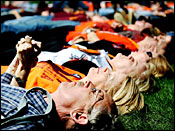
(AP/The News & Advance, Chet White)
Smaller, reflective gatherings were to take place during the day. About 50 people laid down in protest of Virginia's gun laws (left). The protesters stretched out on the grass for three minutes, to symbolize the amount of time they say it takes to buy a gun in Virginia.

A similar "lie-in" was held at the University of Toledo, Ohio, and more were planned for other campuses.

Seung-Hui Cho had a history of bizarre and threatening behavior and had been declared dangerously mentally ill by a court. Under federal law, Virginia authorities should have sent his name to an FBI database, and when the gun stores ran their instant background checks his purchases should have been denied.

In the past year Virginia tightened its laws, sending thousands of names to the FBI, and congress gave all the states financial incentives to do the same, but CBS News correspondent Chip Reid reports that progress has been slow at best.

Numbers provided by the Brady Campaign to Prevent Gun Violence show that a year ago there were 166,000 names in the FBI database and today, about 402,000. But an estimated 2.6 million Americans have been declared dangerously mentally ill.

The Brady Campaign's Paul Helmke says that means, "8 out of 10 people that have a history of being dangerously mentally ill are still going to be able to buy a gun in this country."

Others argue that solving the problem isn't as simple as creating stricter gun laws.

"If you have someone who's intent on committing criminal acts and they want to get a gun, they're gonna find a way to get a gun," says Virgina House of Delegates majority leader Morgan Griffith.

Some family members of victims entered War Memorial Chapel early Wednesday for a private service. Other family members of those killed said they couldn't bear to attend the official events and planned to grieve privately.

I won't be able to walk my daughter down the aisle at her wedding. I won't be able to bounce her children on my knee.

Bryan Cloyd, Father of Austin Cloyd
Bryan Cloyd, whose daughter Austin was killed, hopes to plant an oak tree with his wife Renee to honor their daughter's life. It is a way of looking toward the future, he said, rather than reflecting on the horrors of last April 16.

As a Virginia Tech professor and Blacksburg resident, Cloyd has faced reminders of his daughter every day. He believes Austin would want the community to honor her life, but then move forward.

"I won't be able to walk my daughter down the aisle at her wedding. I won't be able to bounce her children on my knee," he said softly. "And I don't think it's helpful to dwell on that, because where that leads is just more sadness. I think what's helpful to do is to dwell on what can be. What can we do with what we have?"

"It's been difficult at times. The nightmares and reliving flashbacks and other things," said Derek O'Dell, who was shot in the arm in his German class. He told CBS News there were 13 people in his class, and five didn't survive.

"I try and not let this event define me. It's tough to not be defined by tragedy, especially when you are in the news as much as I might be," O'Dell said. "It's difficult for people who might not have known me prior to April 16th to learn who Derek O'Dell is. Hopefully I will eventually reach all of my aspirations in life and become a great veterinarian and hopefully change the world for the better, and hopefully become remembered for that, and not just as a survivor."

No public memorials were planned for Cho.

Gerald Massengill, who led a governor-appointed panel that investigated the slayings, has tried to focus his thoughts on the changes that have been made to the state's mental health system and school security procedures in light of the panel's recommendations.

"I think a lot of us have been anticipating April the 16th with some reservations as to how it would impact us," he said. "And I think as it's gotten closer, what I have tried to consume myself with are those things ... the lessons that we think we could learn from Virginia Tech."

Original here