Sunday, June 15, 2008

They Earn $200,000 and Pay No Taxes

Find Out How These Rich Folks Avoided Paying Any Income Taxes


Death is inevitable, but federal income taxes aren't for an increased number of high-income earners.

Rich couple
(Getty Images)
More Photos

New IRS statistics show 7,389 federal tax returns with $200,000 or more in adjusted gross income reported no federal income taxes in 2005. That's a 161% jump from the 2,833 comparable returns filed in 2004.

Additionally, 4,224 of the over-$200,000 earners reported no worldwide income tax liability on their 2005 returns, the IRS data show. That represents a 75% increase from the 2,420 comparable returns filed in 2004.

The data are the most recent available from the IRS. It shows a rising number of high-income earners have avoided the alternative minimum tax, which was intended to ensure that tax shelters, deductions and loopholes wouldn't exempt wealthy Americans from paying at least some federal income tax.

"It's an interesting case study on how people find ways to avoid paying taxes," said Howard Gleckman, a senior research associate and tax blog editor at The Tax Policy Center, a joint venture of the Urban Institute and the Brookings Institution.

The increases stem in part from two tax law changes, according to the IRS Spring 2008 Statistics of Income Bulletin.

Responding to Hurricane Katrina, Washington exempted charitable contributions between Aug. 27, 2005, and Jan. 1, 2006, from the overall limit on itemized tax deductions and the 50% of adjusted gross income limit for such giving. The one-time change wasn't limited to hurricane-related contributions.

"There was no excuse for not restricting it to the affected area," said Joann Weiner, a former Treasury Department employee who analyzed the changes in her current job as a contributing editor at Tax Analysts, a non-profit publisher of tax information and data.

Under the American Jobs Creation Act of 2004, Washington also allowed taxpayers to eliminate up to 100% of their alternative minimum tax liability by using credits for any foreign taxes paid. Before tax year 2005, those credits could only eliminate 90% of federal income taxes.

High-income earners — guided by accountants and tax advisers — reacted swiftly to the change, which remains in effect. In 2004, IRS data show they reported $16.6 million in foreign tax credits. The following year, the total credits claimed soared to $447.3 million.

"You can make the case for this on the merits: You've paid taxes on the income once, why should you have to pay it again?" Gleckman said.

He and other tax specialists said they were unsure whether the no-taxes-paid trend is likely to accelerate. But they offered greater assurance that federal officials anticipated the likely outcome of the tax law changes.

"My sense of it is that the people who introduce these provisions know exactly who is going to benefit," Gleckman said.

Original here

Fuel price rises hurt volunteer drivers

Cancer Society volunteer Joe Clark drives Bronwyn Gore to Auckland City Hospital from Papakura once a week. Photo / Martin Sykes

Cancer Society volunteer Joe Clark drives Bronwyn Gore to Auckland City Hospital from Papakura once a week. Photo / Martin Sykes

Charities are alarmed at mounting numbers of volunteers quitting because they can't afford rising petrol costs.

The Auckland Cancer Society and Meals on Wheels have both lost volunteer drivers since petrol prices passed $2 a litre last month.

The Prisoners Aid and Rehabilitation Society says the number of family visits to prisoners has also dropped in the past two months because of petrol prices.

BP offers petrol vouchers for volunteers but says applications have far exceeded the amount of money available, which is confidential.

Shell and Chevron (Caltex) do not have any similar schemes and Mobil did not return calls.

Papakura cancer patient Bronwyn Gore, 50, said she depended on the Cancer Society's volunteer drivers such as 83-year-old Joe Clark to get to daily radiotherapy appointments at Auckland City Hospital, a round trip of 70km.

"My family are scattered and the only family member in this direction works fulltime, so I've had to rely on the volunteer drivers," she said.

"It means the difference between me having all my treatments and having to miss out because I can't get into the hospital. If it wasn't for the volunteer drivers I don't know where I'd be."

Mr Clark, who has been a volunteer driver for 12 years, said he could afford to keep going. But Cancer Society support services manager Faye Kenny said other drivers had begun to resign in the past two weeks because they could no longer afford it.

"Even though we've offered more petrol vouchers, I think they felt that the whole cost - the maintenance of the car and everything else about providing that service - is just beyond them," she said.

The society gives out $28,000 worth of petrol coupons a year, but Ms Kenny said that covered only a fraction of the costs of the 500 volunteers.

"We are really concerned that that is rapidly not going to be enough so we are going to have to raise that money somehow."

The Meals on Wheels co-ordinator for Central and South Auckland, Karen Clare, said she'd noticed more volunteers resigning partly because of petrol prices in the past few months.

Her counterpart for North and West Auckland, Jan Smith, said she had started noticing the same trend just in the past fortnight.

Red Cross, which runs the scheme in Auckland, pays its 1100 volunteer drivers just $2.50 a day as a contribution to petrol costs.

"I still get a lot of people who donate their petrol money back because they want to contribute. But for some others, it's difficult," Mrs Smith said.

Prisoners Aid national director Lyanne Kerr said her group received $72,000 a year from the Corrections Department to help families visit prisoners in jail, but that meant only $20 to $40 each for trips that often cost much more than that.

"We've had a real drop-off in the last few months where people who were going monthly are now going two-monthly or twice a year," she said.

BP's "Vouchers for Volunteers" scheme attracted more than 3000 applications when launched in 2006 and more than 1100 last year, but only 317 organisations were granted vouchers.

Spokeswoman Diana Stretch said the scheme would be run again this year but the dates were not yet decided and the amount available was "commercially sensitive".

The scheme is for not-for-profit agencies whose volunteers do significant driving as part of their volunteer work. Shell said it helped volunteers through its sponsorship of Barnardos and Chevron (Caltex) said it did its bit by sponsoring the Starship hospital.

* To volunteer for the Cancer Society ring (09) 308-0244.

Original here

Karzai issues warning to Pakistan

ISLAMABAD, Pakistan (CNN) -- Afghan President Hamid Karzai warned Sunday his troops would take their battle against Taliban extremists across the border into Pakistan to prevent them launching attacks in his country.

art.jpg

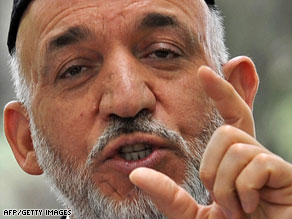
Hamid Karzai says his troops have the right to cross into Pakistan to pursue militants.

Karzai told reporters in Kabul on Sunday that Afghan soldiers had the right to enter Pakistan because insurgents crossing the border to attack Afghan targets "gives us the right to go back and do the same."

The Afghan president has previously urged Pakistan and its U.S.-led coalition allies to do more to tackle extremists holed up in Pakistan's remote border regions, but this is the first time he has indicated taking matters into his own hands.

Karzai said his administration's "patience was running thin." He said the cross-border attacks have destroyed homes and schools.

"This is a two-way road, and Afghans are good in two-way road journeys," he said. "We will complete the journey, we will get them and we will defeat them. And we will avenge all that they have done in Afghanistan for the past so many years."

Pakistan's prime minister responded that his country would not "allow" Afghan troops in.

"We will neither interfere in the internal affairs of any country, nor will we allow anyone to interfere in our affairs," Yousuf Raza Gilani told Pakistan's private ARY-OneWorld television.

"Such statements will not help in the normalization of friendly relations between the two countries, and will hurt the sentiments of people on both sides of the border," he said.

Gilani added that his country wants "friendly" ties with Afghanistan.

Karzai's comments came as Afghan and coalition forces killed more than 15 insurgents and captured five while searching for militants who escaped in a daring jail-break in the southern city of Kandahar.

The jail breakout, which saw hundreds of Taliban fighters take flight, has come as major blow to efforts to suppress the extremists, just as coalition forces appeared to be gaining the upper hand

In his address Sunday, Karzai named several militant leaders by name -- including Baitullah Mehsud, the leader of the Pakistani Taliban. .

Mehsud had been identified by Pakistan President Pervez Musharraf's administration as the mastermind behind last year's assassination of former prime minister and opposition leader Benazir Bhutto. The CIA reached the same conclusion.

Last month, Pakistan's new government said it was negotiating a deal with the Mehsud tribes of South Waziristan that involved exchanging prisoners and withdrawing Pakistani forces. Amid the negotiations, Baitullah Mehsud declared a cease-fire.

"Baitullah Mehsud should that know we will go after him and hit him in his house," Karzai said.

He added: "The Pakistani government should know it. We will come and hit him there, wherever he is."

The issue of cross-border raids came to the forefront last week after a U.S. military airstrike inside Pakistan soil killed 11 Pakistani troops.

A U.S. official with knowledge of the incident told CNN that Tuesday's airstrike targeted suspected militants who had fled into Pakistan after conducting an ambush on the Afghan side of the border.

The official said the mission was permitted under the rules of engagement, which allow "hot pursuit" across the border of suspected militants when locations are verified.

The top spokesman for the Pakistan army, Gen. Athar Abbas, told CNN that the airstrike occurred after U.S. forces were called in by Afghan troops who had engaged in a border clash with Taliban forces.

The Taliban forces fired on the Afghan troops as they tried to set up a checkpoint in a disputed area along the Afghan-Pakistan border, Abbas said.

The Afghan troops then called for help from the U.S.-led coalition forces, which carried out an airstrike on positions where Pakistani paramilitary forces were stationed, Abbas said.

Original here